Wednesday, April 29, 2015

From Sorrow to Strength

Nepal has been hit by very big earthquake (Mw=7.9) on the 25th of the April 2015. This sudden event has taken the lives of thousands of people and put significant loss on the economy. We are saddened by this event. To all people affected directly and indirectly, we want show our solidarity with you all. Our prayers are with you.

Our regular contributor Dr. Pralhad Uprety has contributed a very contextual article in Nepali for the fellow people. The article titled Lessons to be learnt from the Nepal Earthquake (नेपाल महाभूकम्प २०७२ बाट सिक्नु पर्ने पाठहरू) has been published in widely read online newspaper "Samudrapari.com". Please do share the news to Nepali community for benefit for all. We have to change sorrow to strength from this event.

The link for the article is:
       http://samudrapari.com/20150428127893.html

Monday, April 13, 2015

Happy New Year 2072 B.S.


New Year- New Resolutions
New Moments and Aspirations


Wishing a very Happy New  Year 2072 B.S
to all our valued readers & well wishers.

नयाँ वर्ष २०७२ को हार्दिक शुभकामना !!!

Saturday, April 11, 2015

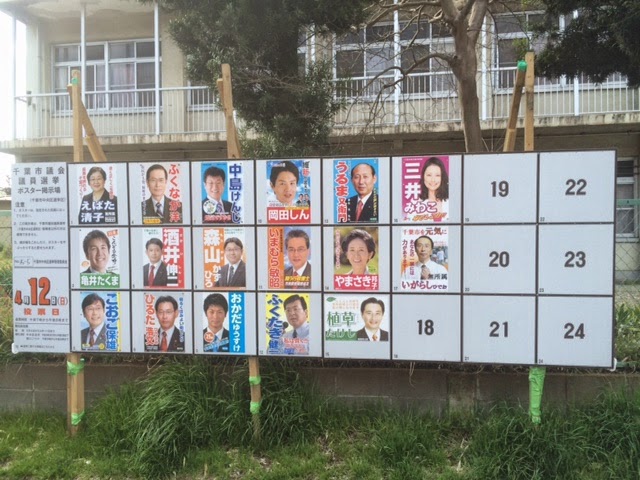
Day in Photo-36

Election Fever in Japan

Tuesday, April 7, 2015

Hanuman Chalisa in Nepali

It is good news to share with our valued readers that the much famous Hanuman Chalisa in Hindi by the great saint Tulasidas has been translated in Nepali language by the Dr. Eng. Pralhad Uprety. Hanuman, the ardent devotee of the Lord Rama is very well known God among Hindus. The following is the first snapshot of the  pdf book.

Caption of Hanuman Chalisa in Nepali

The pdf book will be uploaded soon and notified so  that many will be benefited. Jay Hanuman!

Wednesday, March 25, 2015

Day in Photo-35

Majestic Mt. Fuji  in Japan as seen from Bullet Train/Shinkansen
(Photo: Dr Pralhad Uprety)

Wednesday, March 11, 2015

4th Anniversary of the Japan Mega-earthquake 2011


Today is the 4th year of the Mega-earthquake 2011 that occurred the Northern Japan hitting severely and killing more than 20,000 people mainly due to the Tsunami induced through the earthquake. It is also the most costly disaster in the modern times till date. RIP for the all victims of this disaster.

Example of destruction due to tsunami in 2011
(Photo by Dr Pralhad Uprety)
One of the consequences of the disaster is the destruction of Fukushima Nuclear plant causing a massive radioactive leakage after the Chernobyl accident in former USSR in 1990s. It had a huge repercussions on the surrounding environments and there was even probation order within certain distance as no man's land from its center. Because of the protest from the local people the Japanese government has decided to decommission this nuclear facility.

Moreover, this disaster exemplifies that there is nothing invincible for the mother earth. Whatever strong infrastructures are made to our best knowledge, if they are hindering the path of mother earth it will sure to crumble sooner or later. So, there is no disaster proof structure as such although some people talk about this. This is just ridiculous. It is a fact that we can made structures more stronger and disaster resistant only but there is no full proof.

Against the countermeasure against the natural hazard turning into disaster, we must carryout comprehensive implementation of interdisciplinary strategies to improve the survival rate and the reduction in economic loss. Building up resilience against the impact of  disaster in the worst case scenario of the area of concern is utmost. Leaders and researchers must come forward and sensitize the people to go hand in hand for the noble cause of disaster risk reduction.

Tuesday, February 10, 2015

The Great Buddha of Kamakura, Japan

Once a capital region for about 100 years, Kamakura is one of the best talked places to visit for the foreigners. The main attraction is the big statue of Amitabha Buddha (阿弥陀仏 Amida Butsu in Japanese) which is 13.35 meter tall weighing 121 ton. It was built around 1423 circa with the collection of funds from devotees and well-wishers without any state support. It is cast in bronze with elaborate use of the joints which can be observed by visiting interior of statue.

The Great Buddha of Kamakura
(Photo credit: Dr Pralhad Uprety)
Located in Kamakura city in Kanagawa Prefecture, it is 1.5 hour drive from Tokyo Station and 1.5 km west from the Kamakura railway station. The entry to temple complex requires fee and one can even enter the interior of the statue by paying extra fee inside the temple complex. The statue was covered previously but the 1495 tsunami swept away  the temple structure and since then it is open to the sky to these days. It is said that with the fall of the area as capital status (capital was shifted to Kyoto) it did not get the state fund for reconstruction.

It is one of the national treasures in Japan and she is trying to list it in the UNESCO World Heritage list. Wishing  all the best in her efforts!!!!!.

Friday, October 24, 2014

World is small...

World is small!!! Lets live in harmony.
(Photo: Dr Pralhad Uprety)

Day in Photo- 34

Magnificent  Chiba Castle
( Photo Credit Dr. Pralhad Uprety)

Tuesday, October 21, 2014

Photo in Day -33

Tapir
(Photo Dr. Pralhad Uprety)

Saturday, October 18, 2014

Photo in Day-32

Red Panda
(Photo Dr. Pralhad Uprety)

Friday, July 25, 2014

Sorry state of India and its implications on Nepal

There have been a buzz of India regarding its health issues, poverty and sanitation problems even though it is one of the rising economic powers in the current time. Following highlights the state of India.

Literacy: 74%
Life expectancy : 68%
Most Polluted City in the world : New Delhi
Open Defecation : 50 % (620 million)
                              more than the population of Europe or twice that of USA
Poor people : 179.6 million  in 2013
                      (20.6% share of world's poor but 17.5%  share  of global population )


It is often compared that  India has more poor people than that of  all the African countries combined. The sorry state of environment are due to unplanned industrialization, illegal mining and waste mismanagement are some of the burning issues of India. In addition to these, the rampant open defection (50%)  has not only posed environmental problem but also have created the situation of cholera, dysentery and many more. To compare this Bangladesh has only 3%  open defecation and China just 1%. In spite of the fact that there is increased calorie intake than the previous time, the defecation has increased the exposure to the diseases thereby not only causing  death but also making stunting and intelligence problems in children thereby continuing the vicious cycle of poverty. The track record on public funding for the sanitation is just 1 (($400 million)   compared to 60 ($26 billion)  for food and job sectors. This has huge repercussions to the Indian society as sick society can not prosper in long run. According to the research recently reported in New York Times, INDIA HAS BECOME RISKY PLACE TO RAISE  CHILDREN.


It is great concern to Nepal (population just 26 million) because it has free entry system with India. Millions of people cross the border for education, shopping, medicine and tourism. Moreover, being a big neighbor its impact is obviously high. Any untoward incident in India has sever repercussions in Nepal. It is hoped that: More the India prosper the more the Nepal will prosper. As development is contagious and in fact the trickling effect of prosperity will benefit Nepal too. In this context the poor and sick states of India (Bimaru states in Hindi) are Bihar, UP and Bengal which are the biggest population bases  (more than 400 million ) of India are the border of Nepal. It is high time that Indian society and government should come forward in sanitation culture and bring the clean and hygiene society not only for its benefit but also for the global health concerns. All countries including Japan (which has severe obsession on cleanliness and sanitation) should help India. Even Nepal should help India in by sharing its positive experiences (like Attitude and Practice) in sanitation and health sectors.

Thursday, July 24, 2014

For the India-Nepal Goodwill

India in Numbers 

Size: 3,287,590  km  ( 7th Largest in World)
Population ( 2011 census)  1.21 Billion (2nd Biggest in World)
GDP: $ 2 Trillion (10th Biggest in World)
Borders by land: 6 countries
                             (Nepal, China, Pakistan, Bangladesh, Burma and Bhutan)
Territorial Issues: 5 countries 
                            (Nepal, China, Pakistan, Bangladesh and Srilanka)


Territorial issues between China and India comes from the  Chinese occupation of Tibet in 1950s and with Pakistan from the Jammu and Kashmir. Since Bangladesh was East Pakistan it has some issues from the very birth of India and Pakistan.

But it is interesting to note about the territorial issues between India and Nepal. It is to be noted that India is about 22 times larger than Nepal. Given the friendly past it seems unnatural that both Hindu majority nations have border issues. However, it is the fact that there are border issues including Kalapani (source of Mahakali river in the Western boundary of Nepal), Susta in Nawalparasi district. Kalapani is in Indian occupation in 1960s (after the Sino-India war in 1962 where India was defeated with humility from China). Nepal has border accord with China in the 1960s but with India it was set up to complete in 1980s but is yet to complete . The main reason is India wants to sign the strip maps excluding the Kalapani and Susta. Nepal of course denies this. It is to be noted that after British India and Nepal had broadly defined the area during the Junga Bahardur Rana premiership. There were appropriate pillars (Junge pillars) along the border maintaining the good border environment. The friendship treaty and recognition of sovereign state in 1923 made further bonding between two nations. But Indian state mechanism  with colonial mentality and narrow heart started problem once India got independence in 1947. Many reports have emerged that Indian SSB force along the Indo-Nepal border has harassed  the Nepali people crossing India and asking for bribe. Those who are challenging are tortured and severely beaten. The No Man's Land (Dash or 10 gaja) is severely encroached by Indian side and is supported by inactions from SSB (border force of India). This has increased the bad image of India among the Nepali citizens.
           After the economic liberalization in 1990s India has progressed a lot and even aspired to be a permanent member in security council of the United Nations citing its area and population. But there are serious objections from its own neighboring nations because of its dismal record as a BIG BROTHER. Many experts opine that- If India seriously wants to have goodwill in aspiring to be a global player it must stop hegemony to small neighboring states and resolve the international border issues as soon as possible. It should start from Nepal as it is the most friendly of all of its neighbors as evident from the fact that she is providing her great manpower (more than 50,000) in its security forces maintaining law and order securing the frontiers. Big country will be great by its virtues not by size and population. Let it be followed in action.

            Narendra Modi, current prime minister of India who has shown acumen in diplomacy by inviting high dignitaries in his oath ceremony, while visiting Nepal this year for SAARC summit must ensure that any in-differences between India and Nepal must be resolved quickly and peacefully. More sooner the better. 


Wednesday, July 23, 2014

Day in Photo- 31

Alien Robot by Pranjal Uprety
(Photo Dr Pralhad Uprety)

Tuesday, July 22, 2014

Day in Photo- 30

Creativity has no bound.
 Pranjal Uprety s using iphone for his Robot.
(Photo Dr Pralhad Uprety)

Tuesday, July 1, 2014

Day in Photo- 29


 Wishing the cold from winter in summer